
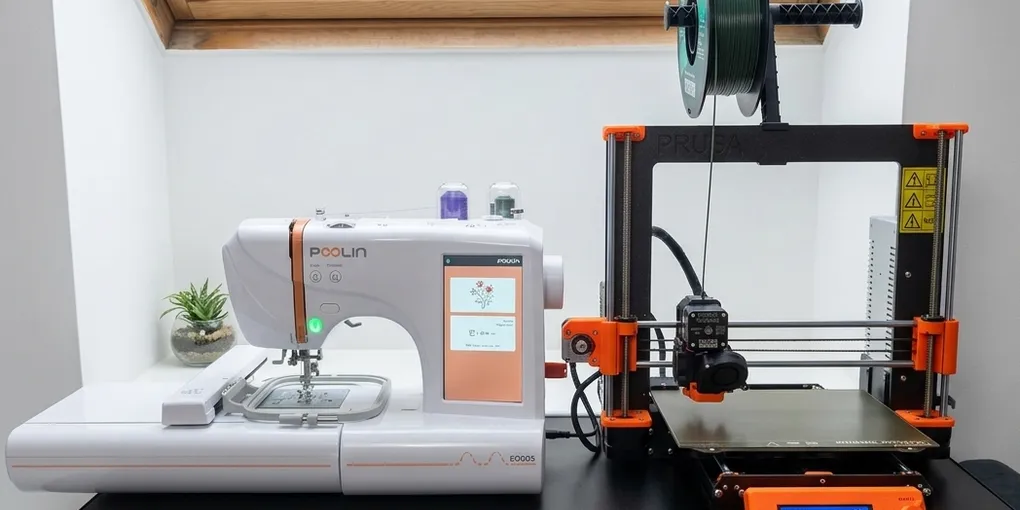
Machine Embroidery: The 3D Printer from the 20th Century
As a maker who has spent years listening to the rhythmic hum of a Prusa i3 MK3 3D printer, I’ve become accustomed to the logic of coordinates, paths, and material flow. I know the satisfaction of a perfectly tuned retraction setting and the importance of a solid first layer.
But at Round Door Workshop, I’ve spent my time mastering a different kind of maker machine. One that was “printing” long before the term became a buzzword. It’s the original additive manufacturing: the embroidery machine.
If you’ve spent years leveling beds and chasing Benchy perfection, the world of high-end embroidery is more familiar than you might think.
The Workflow: Slicing vs. Digitizing
In the 3D printing world, we live in the slicer. We take a model, define the infill, and generate the G-code.
Professional embroidery follows the same engineering principles through a process called digitizing. Instead of layers of plastic, we define paths of thread. Much like how a 3D printer handles overhangs, we must account for pull compensation, calculating exactly how thread tension will move the fabric so the final design looks right.
Hardware Parallels
The transition from a 3D printer to a professional embroidery setup is a natural evolution for any tech-minded maker:
- The build plate vs. the hoop: On the Prusa, it’s a PEI sheet. In embroidery, it’s the fabric tensioned by the hoop. If your “substrate” (the fabric) isn’t taut and perfectly positioned, the print fails.
- Filament vs. thread: Changing a spool of PLA is no different from threading high-sheen polyester. You’re still managing feed rates, tension, and material quality. Different threads have different properties, just like PLA and ABS.
- The nozzle vs. the needle: The needle is the business end of the operation, translating digital coordinates into physical reality with sub-millimeter precision.

A 3D printer has an extra axis, but embroidery can create depth by stitching over a previous layer. There’s a limit, though: after three or four layers, the needle struggles to get through, and things can go pear-shaped quickly.
The Great Trade-Off
While both manufacturing methods are fantastic, they each serve a distinct purpose in a maker’s life.
The 3D printer’s edge: universal utility
The 3D printer is the ultimate fix-it machine. If a bracket breaks in the house or I need a custom jig for a mechanical repair, I can have a functional part in my hand in a few hours. It’s the king of making something in a pinch.
The embroidery machine’s edge: wearable excellence
The embroidery machine, however, is where we achieve permanent quality. A 3D print is a tool; an embroidered design like our Hearts Life Bar on a quality, heavyweight tee is an heirloom. It transforms a premium garment into a piece of artisanal craft that survives the wash, feels substantial to the touch, and carries a “subtle nerd” aesthetic with a sophistication plastic simply can’t match.
The Maker’s Verdict
At Round Door Workshop, we’ve taken the precision of 21st-century 3D printing logic and applied it to the most reliable manufacturing tech of the 20th century.
One machine builds the tools we use; the other builds the quality apparel you wear. Both are essential pieces of the modern maker’s toolkit, and both require the same obsession with technical perfection.